

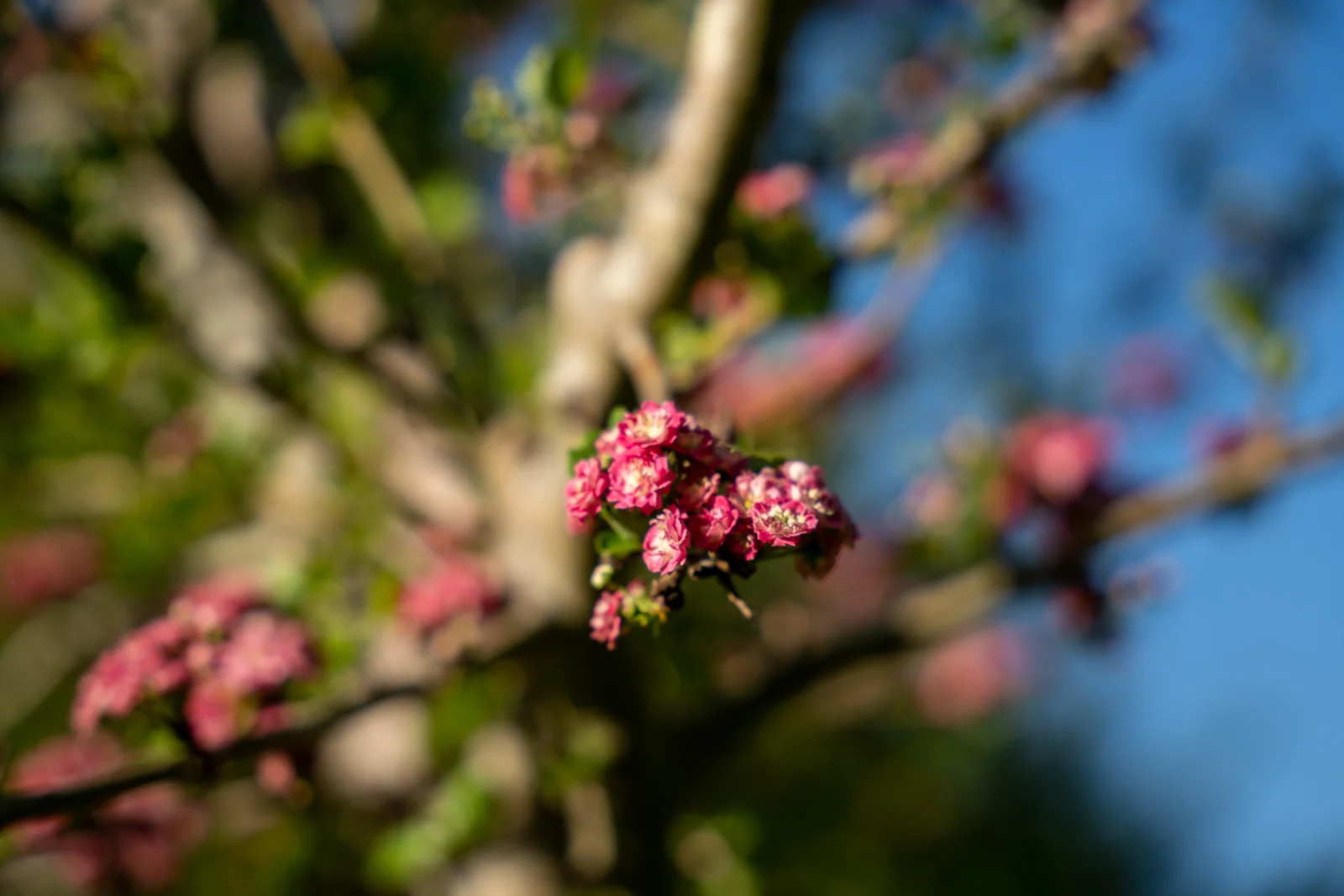
Frost-hardy spring-flowering specimen for German urban planting
Midland Hawthorn ‘Paul‘s Scarlet’ · Crataegus laevigata ‘Paul‘s Scarlet’
A compact, rounded small tree (Zweigriffeliger Weißdorn, red-flowered form) for German projects where late-spring scarlet colour, salt tolerance, and reliable winter performance must coexist on confined urban sites.
Key Facts
About this Cultivar
Winter hardiness (Winterhärte) is the foundation of this cultivar's value on German projects. The parent species Crataegus laevigata performs reliably from Winterhärtezone (WHZ) 5b to 8a, equivalent to dependable wintering below minus 25 degrees Celsius on free-draining substrates. This places it well inside the safe envelope across the norddeutsche…
Read more
Show less
Winter hardiness (Winterhärte) is the foundation of this cultivar's value on German projects. The parent species Crataegus laevigata performs reliably from Winterhärtezone (WHZ) 5b to 8a, equivalent to dependable wintering below minus 25 degrees Celsius on free-draining substrates. This places it well inside the safe envelope across the norddeutsche Tiefebene (northern German lowlands), the Niederrheinische Bucht (Lower Rhine basin), and the Voralpenland (pre-Alpine foothills), with no meaningful eastern limit within Germany.
Street tree suitability (Stadtbaumeignung) is supported by moderate de-icing salt tolerance, tolerance of compacted urban soils, and full pavement tolerance once established. The rounded habit (Habitusform) reaches 5 to 7 metres in height and 4 to 7 metres in spread, holding scale on confined inner-city sites where the Stadtbaum-Kanon of Linde and Ahorn is too large. Growth is slow, which reduces pruning cycles under typical German Straßenbaum regimes.
Flowering runs March through May in dense corymbs of double red flowers, with the dark green foliage emerging in parallel. This is the cultivar's distinguishing trait against the parent species, whose flowers are single and white; 'Paul's Scarlet' sets very little fruit, removing the slip and stain concern on paved surfaces. Pollinator value is reduced relative to the wild Weißdorn but not absent.
Site requirements (Standortansprüche) are undemanding. The species accepts acidic, sandy, and heavy clay soils, performs in full sun and partial shade, and shows moderate drought and heat tolerance once the root system is established. Disease and pest resistance are moderate; 'Paul's Scarlet' is susceptible to fireblight (Feuerbrand, Erwinia amylovora) under conducive conditions, which warrants consideration where the planting list is screened against that pressure.
Landscape application is as a specimen, in small groups, in low alignments along secondary streets, or as a tall flowering hedge. The cultivar reads as a measured, scale-appropriate alternative to larger flowering Prunus on sites where winter reliability outranks summer drama.
Advice on this species
Want to know more about Crataegus laevigata 'Paul's Scarlet'?
Tell us about your project and we'll advise you on this species — where it thrives, which size makes sense, and what to expect once planted.
- Produção própria
- Exemplares adultos
- Resposta em 1–2 dias
Sem compromisso · orçamento personalizado