

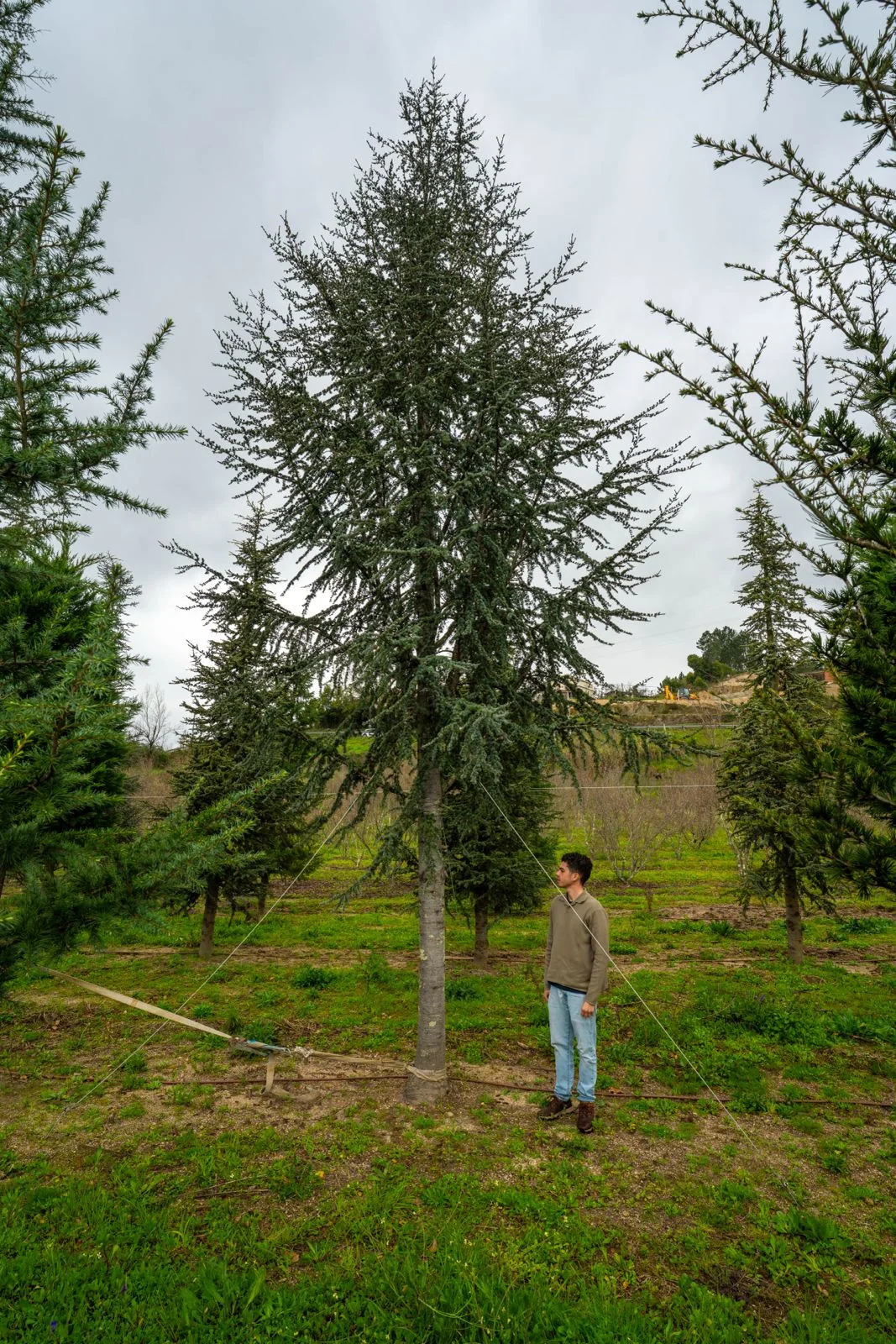
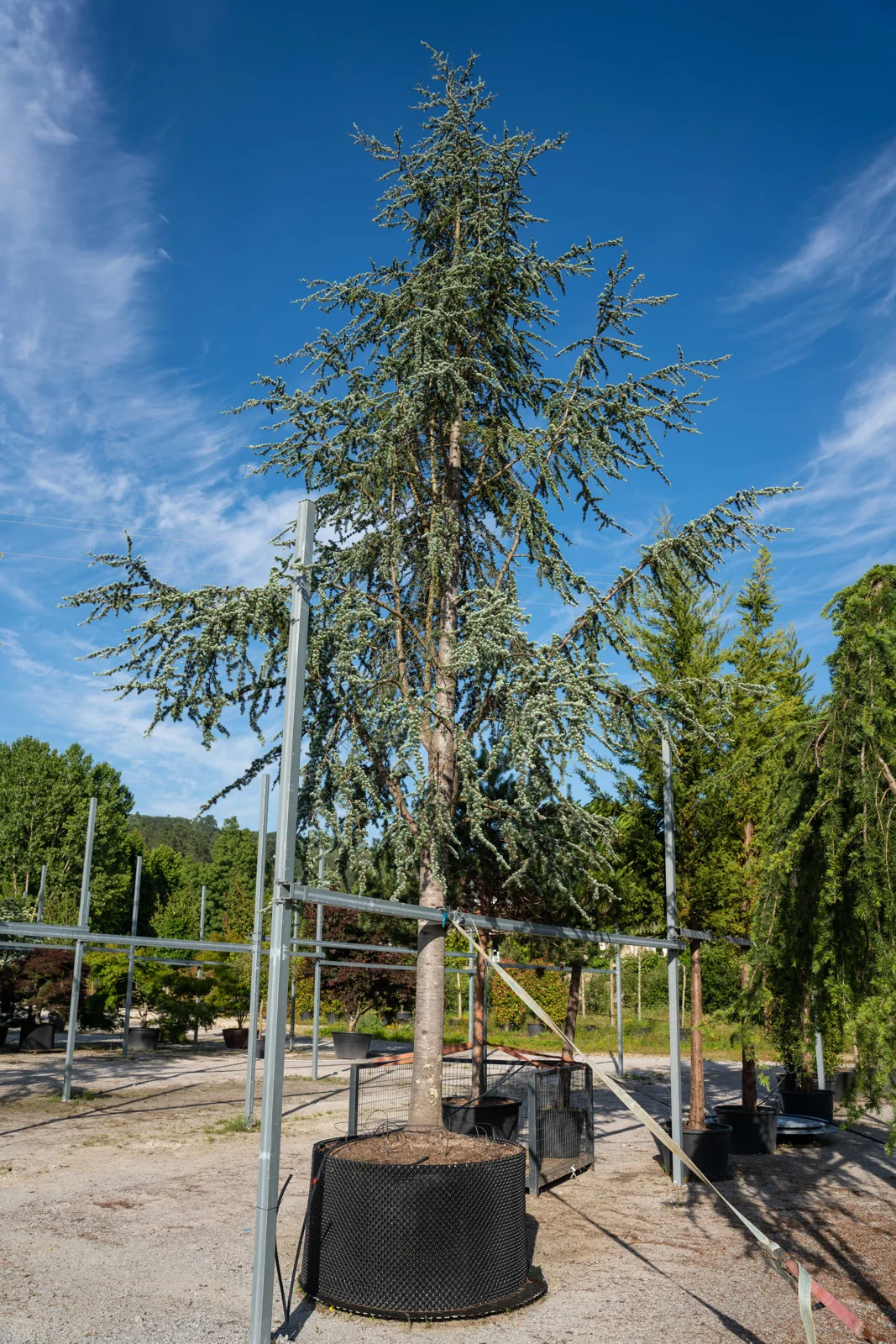
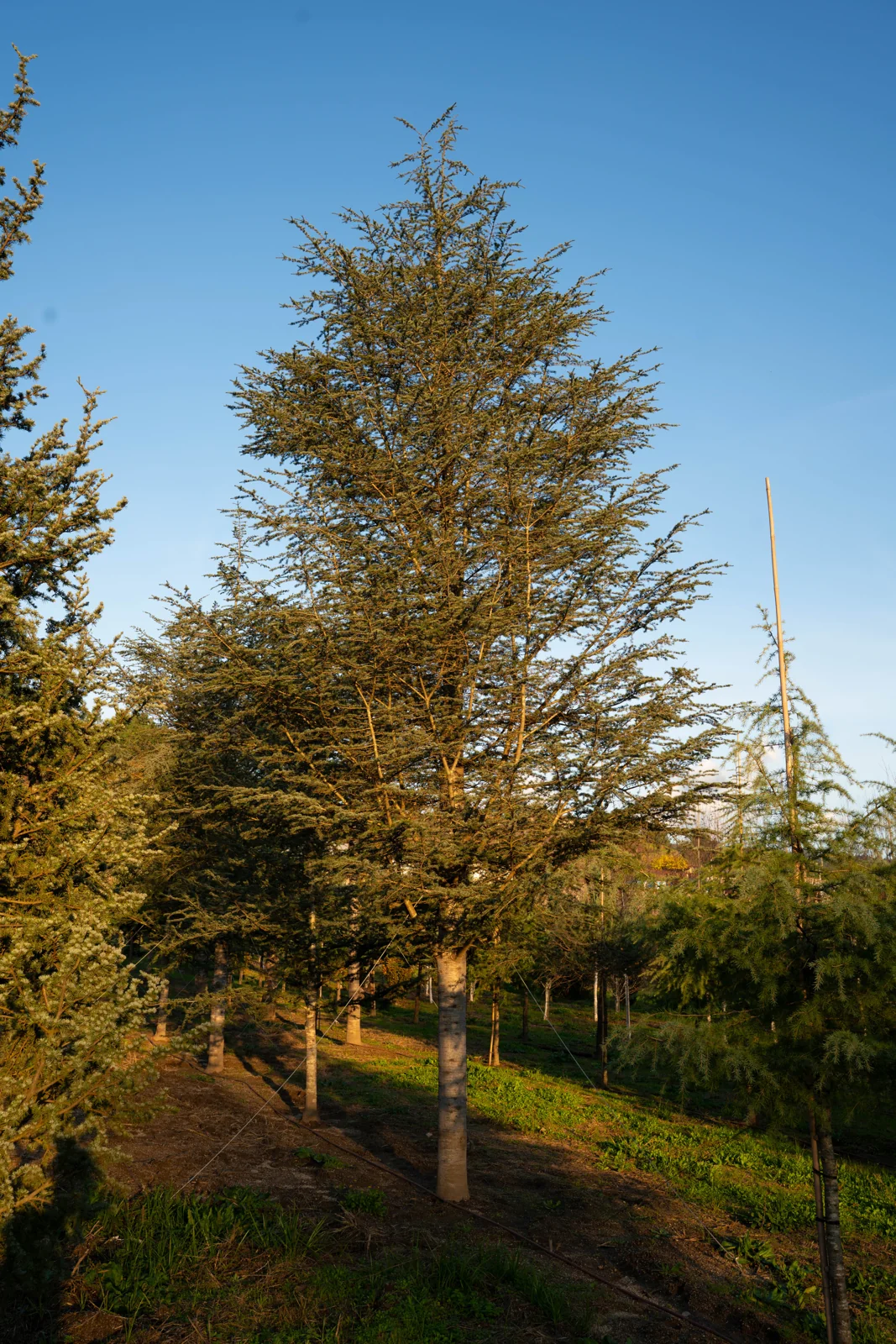
Blue-foliage solitaire for the milder Klimaregionen
Atlas Cedar ‘Glauca’ · Cedrus atlantica ‘Glauca’
A long-lived blue-needled conifer from the Atlas Mountains, suited to solitaire and parkland use in the milder German Klimaregionen, reliable to around minus 18 degrees Celsius on free-draining soils.
Key Facts
About this Cultivar
Cedrus atlantica 'Glauca' (Blaue Atlaszeder) is a slow-growing evergreen conifer with dense tufts of silver-blue needles and a strongly pyramidal habit (Habitusform) when young, opening to a broad, flat-topped silhouette with horizontal branching as it matures. Mature height reaches 15 to 20 metres with a spread of 6 to 10 metres over decades; on German…
Read more
Show less
Cedrus atlantica 'Glauca' (Blaue Atlaszeder) is a slow-growing evergreen conifer with dense tufts of silver-blue needles and a strongly pyramidal habit (Habitusform) when young, opening to a broad, flat-topped silhouette with horizontal branching as it matures. Mature height reaches 15 to 20 metres with a spread of 6 to 10 metres over decades; on German sites it follows the same trajectory more slowly than in Iberian cultivation. The blue foliage is the defining character of the Glauca Group within the species, holding colour year-round.
Winter hardiness (Winterhärte) is the central specification question. The species is reliably hardy to approximately minus 18 degrees Celsius on free-draining substrate, with minus 20 degrees Celsius a defensible limit on established trees in sheltered positions. Performance is dependable across the Oberrheingraben (Upper Rhine valley), the Niederrheinische Bucht (Lower Rhine basin), and the milder parts of the Rhein-Main and Stuttgart basins. The species becomes marginal east of the Elbe, in Brandenburg and Saxony, and above 400 metres in the voralpenland (pre-Alpine foothills). The first three winters carry the greatest risk; hardiness consolidates as the tree matures.
Site requirements (Standortansprüche) favour full sun and free-draining loam or sand. The deep taproot (Wurzelverhalten) drives reliable drought tolerance once established but is the source of the species' well-documented transplant difficulty, making mature specimen supply the standard route for project use. The cultivar tolerates calcareous substrates and a wide pH range, including the loess soils of the Rhine corridor. De-icing salt tolerance is low, which removes it from roadside Straßenbaum use under routine German winter salting; it is a Solitärbaum for parks, Stadtwald, campus, and representative landscape settings, outside the GALK-Straßenbaumliste context. Phytophthora root rot appears only on impeded drainage, and heavy wet snow can break the horizontal branches of mature trees.
Maintenance is minimal once established: no formative pruning is required and the cultivar carries none of the genus-level phytosanitary pressure currently affecting Fraxinus or Buxus stock in Germany. Within the climate-adapted species discussion (Klima-Artenmatrix, Zukunftsbaum), Cedrus atlantica 'Glauca' occupies a defined niche: a long-lived, drought-tolerant evergreen structural tree for the milder Klimaregionen, with documented limits beyond them.
Advice on this species
Want to know more about Cedrus atlantica 'Glauca'?
Tell us about your project and we'll advise you on this species — where it thrives, which size makes sense, and what to expect once planted.
- Produção própria
- Exemplares adultos
- Resposta em 1–2 dias
Sem compromisso · orçamento personalizado