

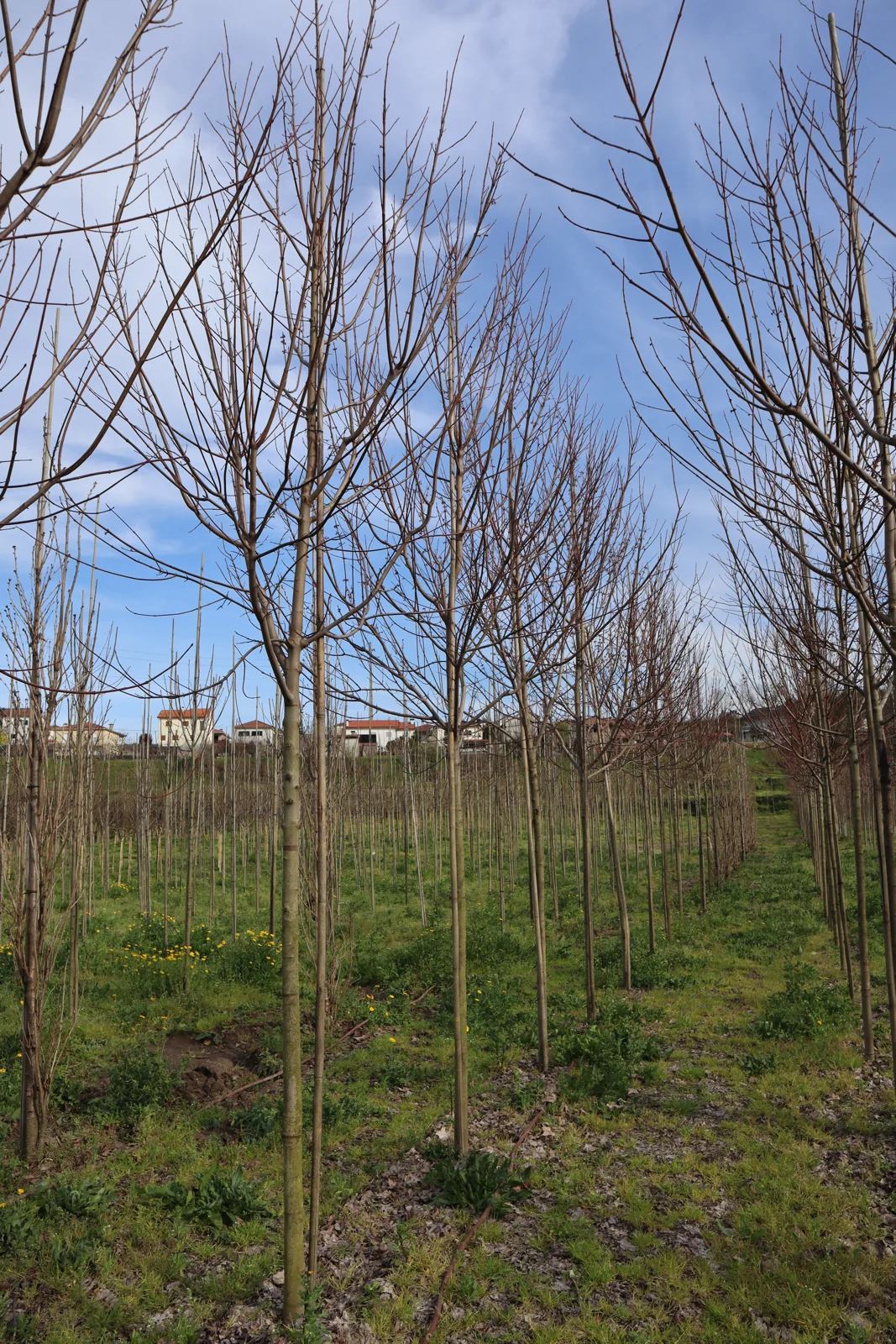
Native Bergahorn for park and cemetery positions, not Straßenbaum
Sycamore Maple · Acer pseudoplatanus
{# A tabela de LOTES (§C, «zoom no lote») foi movida para baixo das características (botânica em cima, lotes em baixo — reunião 24/07). Ver #crm-lotes mais abaixo. #}A native German upland tree, the Bergahorn suits Park-, Friedhofs- and Wohnumfeld-Pflanzungen across most Klimaregionen, delivering fast broad canopy and proven wind- and Streusalz-tolerance as a defensible park and open-ground specification.
About this Species
Bergahorn is native to the German uplands and Alps and to most of the Central European hill country, with a natural range extending from Portugal to the Caucasus. It reaches 25 to 35 metres at maturity with a broad rounded crown, opposite five-lobed leaves, and grey bark that flakes in rectangular plates to expose orange inner tissue. The species is wind-tolerant, fast in early growth, and unusually salt-tolerant for a native deciduous tree.
Winterhärte is not the constraint here: the species is reliably hardy to below minus 25 degrees Celsius and performs across every German Klimaregion, from the norddeutsche Tiefebene through the central uplands to the voralpine Lagen above 1000 metres. It tolerates the cool summers of the pre-Alpine foothills (voralpenland) better than most ornamental maples and is at home in the Stadtwald and Landschaftspark contexts where it has been a standard park and avenue tree for two centuries.
The decisive contemporary issue is Russrindenkrankheit…
Bergahorn is native to the German uplands and Alps and to most of the Central European hill country, with a natural range extending from Portugal to the Caucasus. It reaches 25 to 35 metres at maturity with a broad rounded crown, opposite five-lobed leaves, and grey bark that flakes in rectangular plates to expose orange inner tissue. The species is wind-tolerant, fast in early growth, and unusually salt-tolerant for a native deciduous tree.
Winterhärte is not the constraint here: the species is reliably hardy to below minus 25 degrees Celsius and performs across every German Klimaregion, from the norddeutsche Tiefebene through the central uplands to the voralpine Lagen above 1000 metres. It tolerates the cool summers of the pre-Alpine foothills (voralpenland) better than most ornamental maples and is at home in the Stadtwald and Landschaftspark contexts where it has been a standard park and avenue tree for two centuries.
The decisive contemporary issue is Russrindenkrankheit (Cryptostroma corticale, sooty bark disease), which has accelerated sharply on stressed German Bergahorn populations following the 2018 to 2022 drought sequence and is now the controlling pathological consideration for any specification of this species. Trees on sealed urban sites with compacted soils and restricted root volume are at materially elevated risk, which is why Acer pseudoplatanus does not appear on the GALK-Straßenbaumliste for inner-city Straßenstandorte. Specify it into open Standorte: Park-, Friedhofs- and Wohnumfeld-Pflanzungen, larger institutional grounds, Kurpark and Landschaftspark positions where the soil is not compacted and the canopy is not under chronic drought stress.
Standortansprüche are otherwise broad: well-drained loams are preferred, but the species tolerates clay, calcareous substrates, and the salt loading typical of German Wohnstraßen at moderate exposure. Specifiers should also note Atypische Weidemyopathie, the equine myopathy caused by hypoglycin A in Bergahorn seedlings and seeds; a clear buffer is required between any planting and active horse pasture. With those two constraints respected, the species remains one of the most defensible native specifications for German park and cemetery work.
Disponibilidade & preço
Interested in Acer pseudoplatanus?
Our team can help you select the perfect specimen for your project. Get in touch for availability and pricing.
- Produção própria
- Exemplares adultos
- Resposta em 1–2 dias
Sem compromisso · orçamento personalizado