

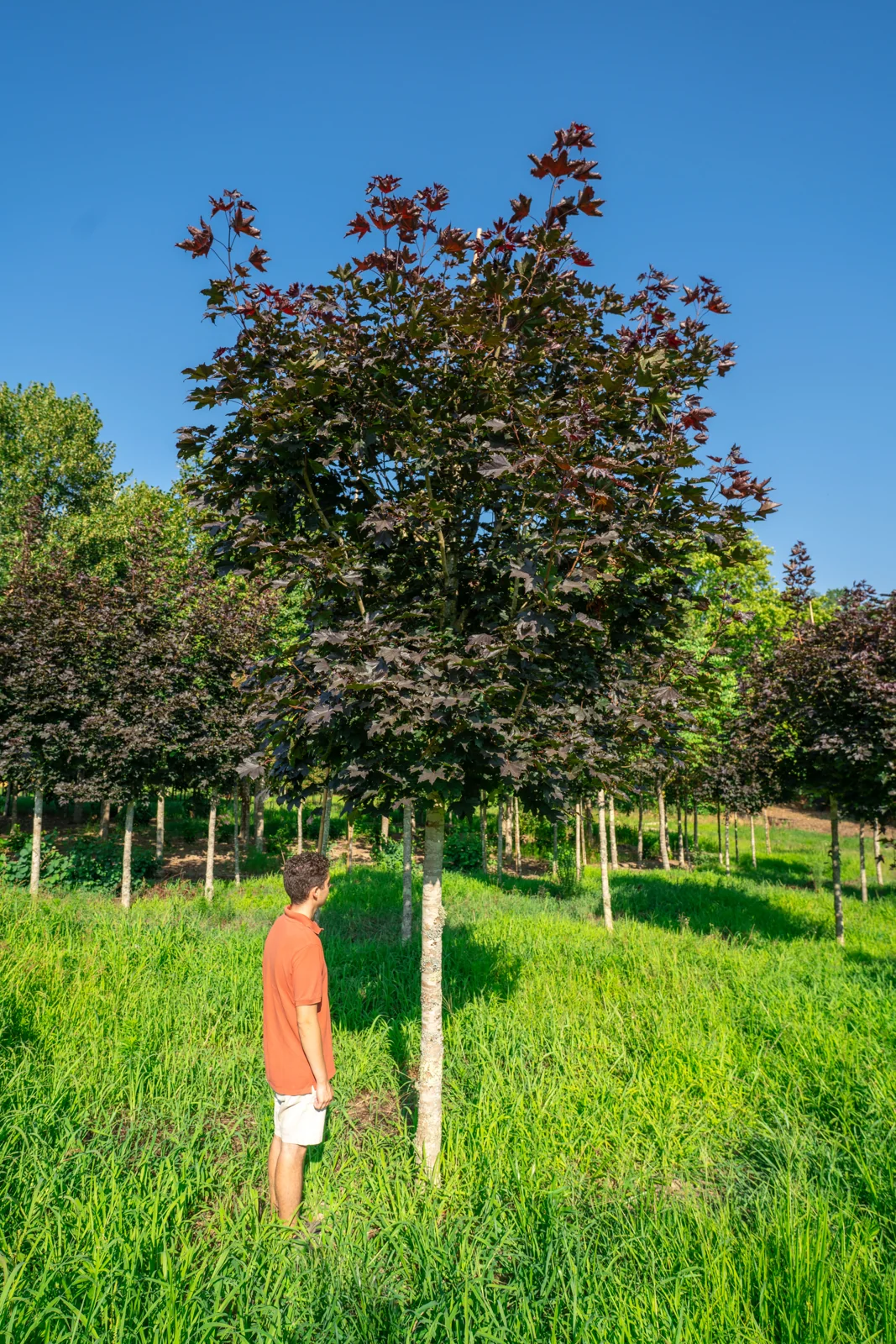
Hardy purple-leaved Spitzahorn for shaded Stadtpark positions
Norway Maple ‘Crimson King’ · Acer platanoides ‘Crimson King’
A purple-leaved selection of the native Spitzahorn (Acer platanoides), 'Crimson King' is specified where dark foliage and dense summer crown are wanted across the full range of German Klimaregionen, holding reliably even in the colder continental east.
Key Facts
About this Cultivar
Acer platanoides 'Crimson King' is a purple-foliage selection of the Spitzahorn, the maple native across central Europe and a familiar canopy tree in the German landscape. The leaves emerge dark maroon, hold that colour through the growing season, and turn red to bronze before leaf-fall. Mature dimensions of roughly 15 to 20 metres in height and 10 to 12…
Read more
Show less
Acer platanoides 'Crimson King' is a purple-foliage selection of the Spitzahorn, the maple native across central Europe and a familiar canopy tree in the German landscape. The leaves emerge dark maroon, hold that colour through the growing season, and turn red to bronze before leaf-fall. Mature dimensions of roughly 15 to 20 metres in height and 10 to 12 metres in spread give a rounded, densely furnished crown, smaller in stature than the green-leaved parent.
Winter hardiness is the cultivar's strongest argument for the German market. The parent species is indigenous from the Niederrheinische Bucht (Lower Rhine basin) through the norddeutsche Tiefebene (Northern German lowlands) to the eastern continental margins, and 'Crimson King' inherits that constitution: reliably hardy to minus 25 degrees Celsius once established, with no observed risk in any German Klimaregion including the colder east of the Elbe and the voralpenland (pre-Alpine foothills) below 600 metres.
Site behaviour follows the species. Crimson King tolerates the calcareous loams of the Rhine valley, the moraine soils of the north-east, and moderately compacted urban substrates, performing best on deep, free-draining loams with reliable summer moisture. Heat tolerance is moderate rather than absolute: in well-irrigated Stadtpark and Kurpark positions and on shaded courtyard sites the cultivar holds its canopy through hot summers, but exposed pavement plantings under the conditions of the 2018 to 2022 sequence show leaf scorch and reduced vigour. Treat it as a shade and structure tree, not a frontline Zukunftsbaum candidate for baking inner-city streets.
Disease and root behaviour are the practical caveats. Verticillium wilt is the genuine pathogen risk and is usually fatal where it strikes; the shallow root plate of the species can crack adjacent pavers and outcompetes turf and underplanting within the drip line. Sited in a Stadtwald, an avenue position with adequate root volume, or a generous Landschaftspark setting where its dark canopy reads against lighter Tilia or Fagus, it earns its place in the Stadtbaum-Kanon as a structural foliage tree rather than a street-tree specification.
Advice on this species
Want to know more about Acer platanoides 'Crimson King'?
Tell us about your project and we'll advise you on this species — where it thrives, which size makes sense, and what to expect once planted.
- Produção própria
- Exemplares adultos
- Resposta em 1–2 dias
Sem compromisso · orçamento personalizado