

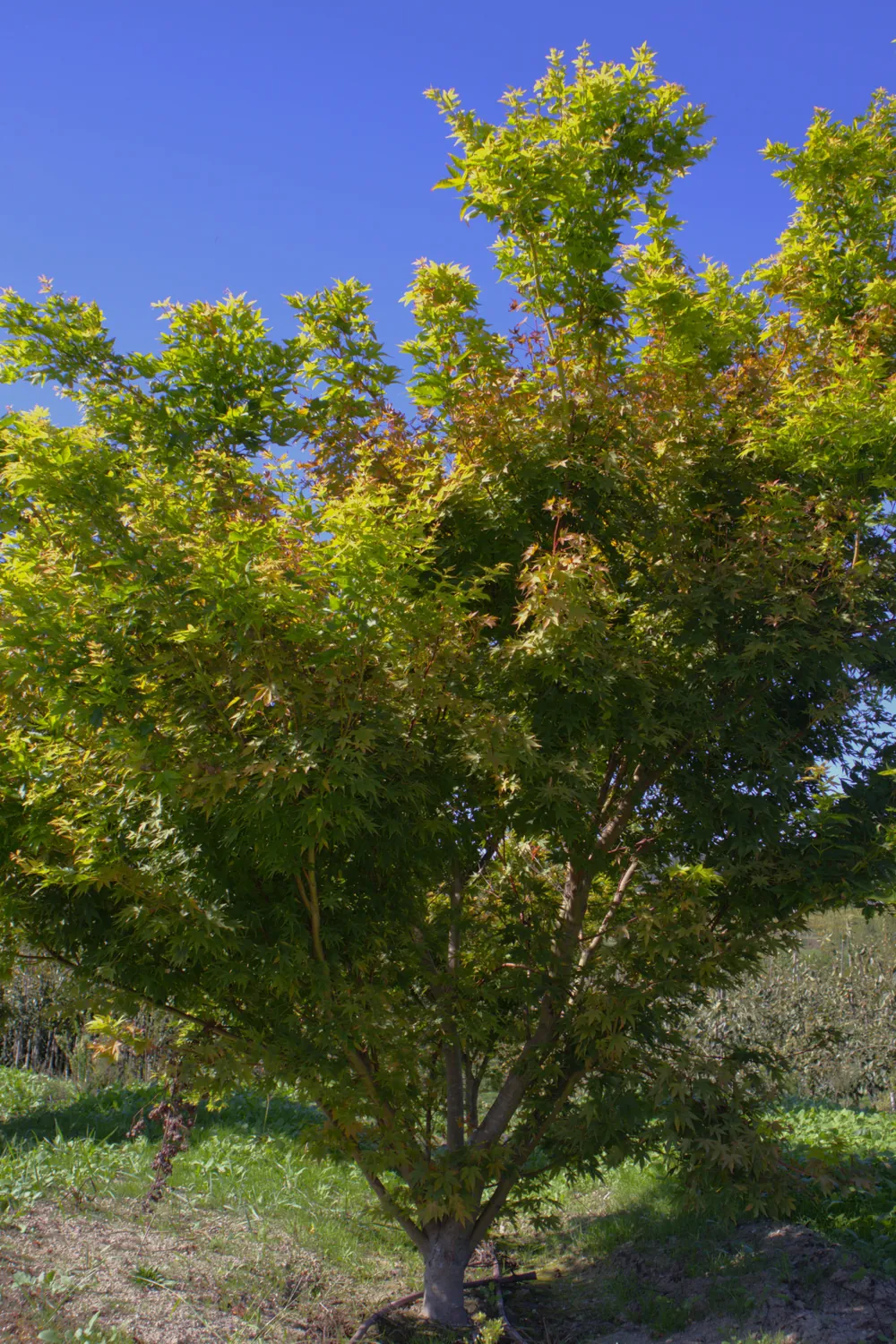
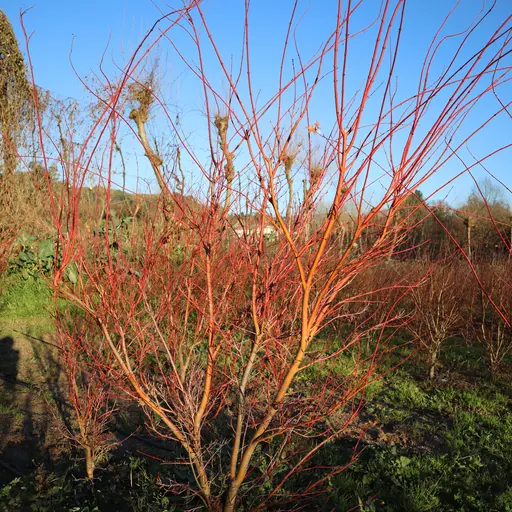
Four-season Japanese maple with coral-red winter bark
Japanese Maple ‘Senkaki’ · Acer palmatum ‘Senkaki’
Selection of Acer palmatum carrying coral-red colouring on one-year shoots through winter. A sheltered specimen for residential and courtyard schemes across mild German Klimaregionen, where winter cold deepens the bark display on protected, free-draining acidic ground.
Key Facts
About this Cultivar
'Senkaki' (synonym 'Sango-kaku', Japanese for coral) is distinguished from the species and from red-leaved palmatum selections by a single trait: coral-red to coral-pink colouration of current-year shoots and young branchwork, which intensifies under winter cold and carries the visual interest of the cultivar from leaf-fall to spring bud-break. Specifying…
Read more
Show less
'Senkaki' (synonym 'Sango-kaku', Japanese for coral) is distinguished from the species and from red-leaved palmatum selections by a single trait: coral-red to coral-pink colouration of current-year shoots and young branchwork, which intensifies under winter cold and carries the visual interest of the cultivar from leaf-fall to spring bud-break. Specifying 'Senkaki' without this winter bark as the primary argument is misuse; the cultivar costs more than the type because of one season, and that season is winter.
Winter hardiness is the gating consideration. Reliably hardy to approximately -15 °C in sheltered positions on free-draining substrate; mature specimens overwinter without damage in the Upper Rhine valley (Oberrheingraben), the Lower Rhine basin (Niederrheinische Bucht), the mild Cologne-Bonn lowland and comparable western Klimaregionen. In open positions in the eastern German lowlands and in the pre-Alpine foothills (voralpenland), prolonged bare frost below -15 °C causes damage to the one-year wood that the cultivar relies on for its display; the first three winters carry the highest risk before the wood hardens. Specification in Berlin-Brandenburg, the eastern lowlands or above 400 m in Bavaria should be limited to sheltered courtyards and warm urban microclimates.
Site requirements (Standortansprüche) are strict. Fresh, well-drained, slightly acid soil with organic matter; intolerant of heavy calcareous loams above pH 7.5 and of seasonal waterlogging. Drought tolerance is low and supplementary irrigation is required even in established stands. The cultivar is not a candidate for street planting (Stadtbaumeignung): it lacks salt tolerance, will not perform under heat-island reflection on sealed substrates, and does not qualify under the Klima-Artenmatrix as a Zukunftsbaum. Exposure should be light shade with protection from afternoon sun in the warmer Klimaregionen.
Form is a slow upright vase in youth, broadening with age to about 4 to 6 m in height and 4 to 5 m in crown spread at twenty years, with a finer branching architecture than the species. Foliage palmate, five to seven lobes, not dissected, pale to yellow-green in summer, with autumn colouring in butter yellow and apricot orange between mid-October and early November. Disease pressure is low; Verticillium wilt is the only material risk on poorly drained sites. Russrindenkrankheit (Cryptostroma corticale) affects Acer pseudoplatanus rather than this species and is not a concern here.
Use as a contemplative specimen (Solitär) against a dark evergreen ground or pale wall that supports the bark reading through the leaf-off months. Pruning limited to sanitary cuts after the third year; the cultivar tolerates hard late-winter pruning poorly.
Advice on this species
Want to know more about Acer palmatum 'Senkaki'?
Tell us about your project and we'll advise you on this species — where it thrives, which size makes sense, and what to expect once planted.
- Produção própria
- Exemplares adultos
- Resposta em 1–2 dias
Sem compromisso · orçamento personalizado