

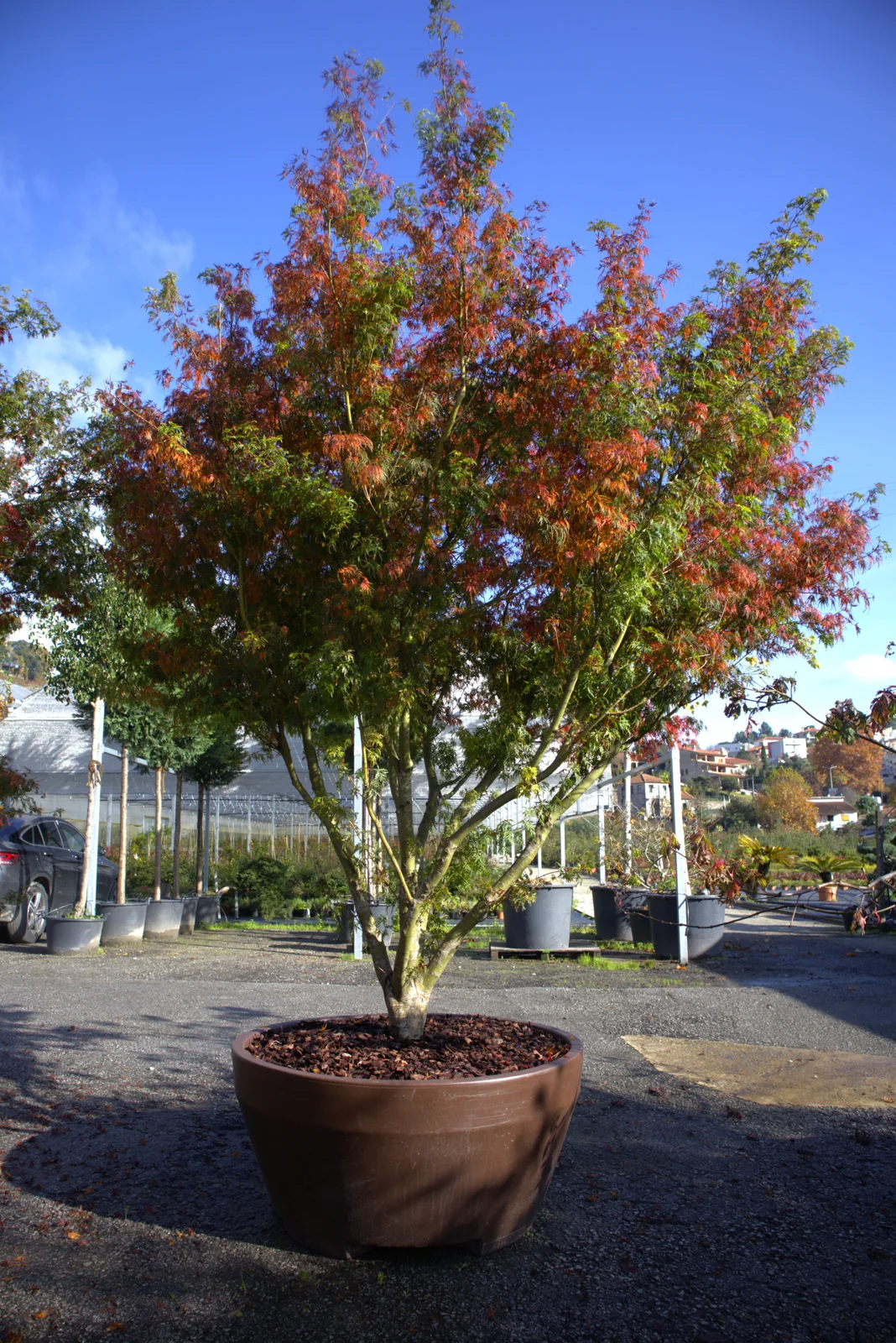
Only upright dissectum Japanese maple cultivar
Japanese Maple ‘Seiryu’ · Acer palmatum ‘Seiryu’
A small, slow-growing Solitärbaum for sheltered courtyards, Japanischer Garten settings, and Kurpark-scale accents. Reliable in mild Klimaregionen on free-draining acidic substrate, holding finely cut foliage and lasting autumn colour where shelter from drying wind is assured.
Key Facts
About this Cultivar
'Seiryu' is the only cultivar within the Dissectum group of Acer palmatum to hold an upright habit. Every other laceleaf cultivar develops a weeping mound shape with branches arching toward the ground; this one forms a small upright tree with a vertical, lightly rounded crown reaching 3 to 4.5 metres in height and 2 to 3 metres in spread at maturity. The…
Read more
Show less
'Seiryu' is the only cultivar within the Dissectum group of Acer palmatum to hold an upright habit. Every other laceleaf cultivar develops a weeping mound shape with branches arching toward the ground; this one forms a small upright tree with a vertical, lightly rounded crown reaching 3 to 4.5 metres in height and 2 to 3 metres in spread at maturity. The Japanese name translates as "green dragon", a reference to the ascending silhouette above the finely cut foliage.
Winter hardiness (Winterhärte) is reliable to approximately -18 degrees Celsius in sheltered sites on free-draining, non-waterlogged substrate; -15 degrees Celsius is a more conservative working limit in open positions, and damage to one-year wood is expected below -20 degrees Celsius under prolonged barefrost (Kahlfrost). Performance is reliable in the Upper Rhine valley (Oberrheingraben), the Lower Rhine basin (Niederrheinische Bucht) and the Cologne lowland, as well as in sheltered urban heat-island positions further east. Marginal in the eastern lowlands beyond the Elbe and in pre-Alpine sites (voralpenland) above 400 metres; not recommended in open exposure across the eastern Mittelgebirge and the cooler norddeutsche Tiefebene without winter protection.
Growth vigour is unusually strong for a dissectum, closer to a species-form Acer palmatum than to a weeping laceleaf cultivar. The framework organises itself without the high-stem grafting and annual crown training that pendulous dissectums require; sanitary pruning in late winter is sufficient. The deciduous foliage is deeply dissected into narrow filaments, a clear luminous green from leaf-out through late summer, with autumn shift through yellow and orange with red highlights between mid-October and late November.
Site requirements (Standortansprüche) match the species: cool, free-draining, slightly acidic to neutral substrate, half-shade obligatory on heat-island sites, where direct summer sun scorches the fine lamina within hours. Drought tolerance is limited and the cultivar is not a Zukunftsbaum candidate under projected hot-summer urban conditions: supplementary irrigation is necessary through the first three growing seasons and during prolonged summer drought thereafter. Crown architecture (Habitusform) is compact and well suited to confined root volumes in walled or container plantings; it is not specified as a street tree under German municipal practice.
Use as a Solitär in courtyards, walled private gardens, large planters on protected terraces, or as a focal specimen under the light shade of a larger overstorey. It substitutes for a weeping dissectum where the design calls for an upright silhouette rather than a cascade, or where the horizontal spread of a high-grafted pendulous cultivar exceeds the available footprint.
Advice on this species
Want to know more about Acer palmatum 'Seiryu'?
Tell us about your project and we'll advise you on this species — where it thrives, which size makes sense, and what to expect once planted.
- Produção própria
- Exemplares adultos
- Resposta em 1–2 dias
Sem compromisso · orçamento personalizado