

Burgundy laceleaf Acer palmatum for sheltered solitary use
Japanese Maple ‘Dissectum Garnet’ · Acer palmatum ‘Dissectum Garnet’
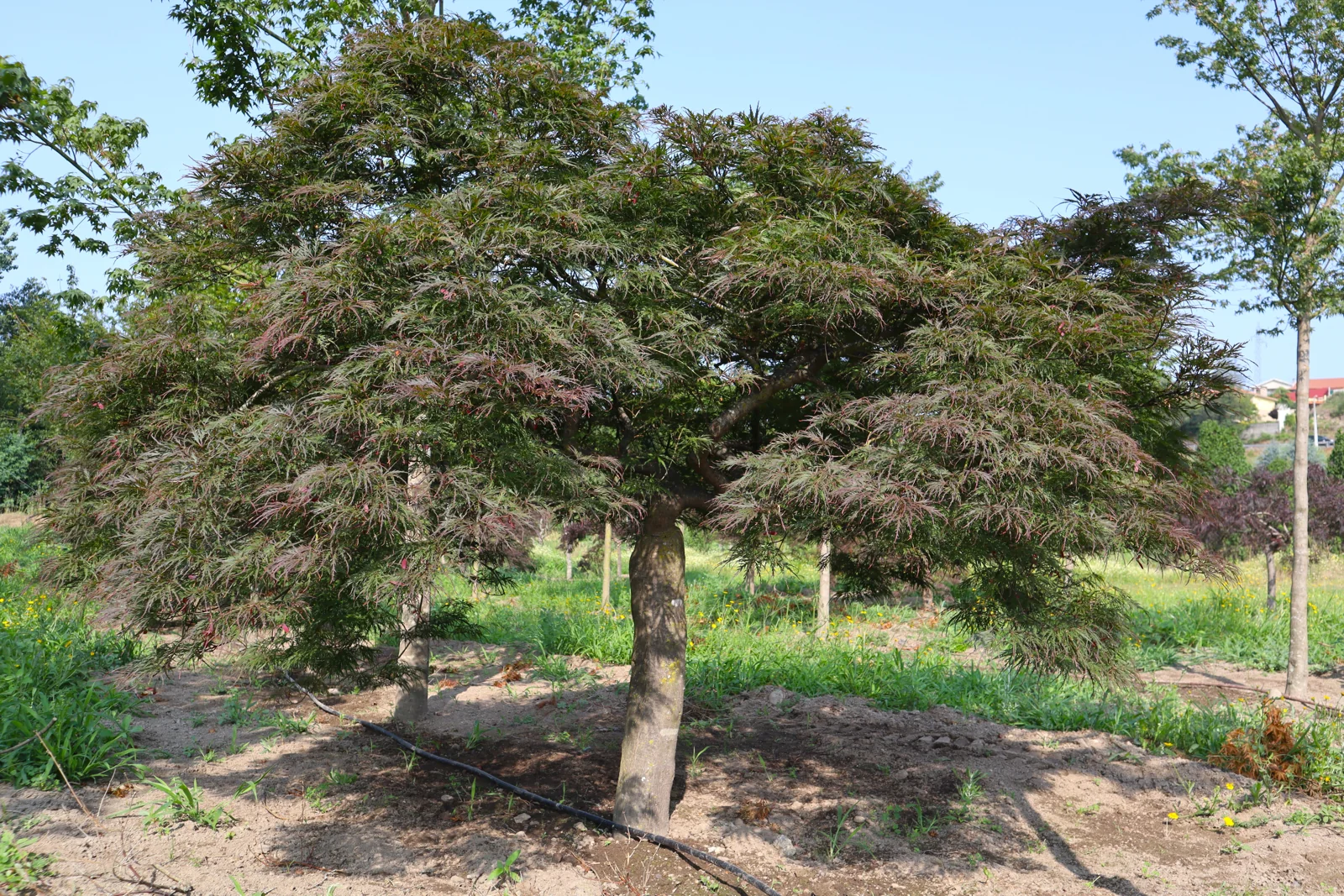
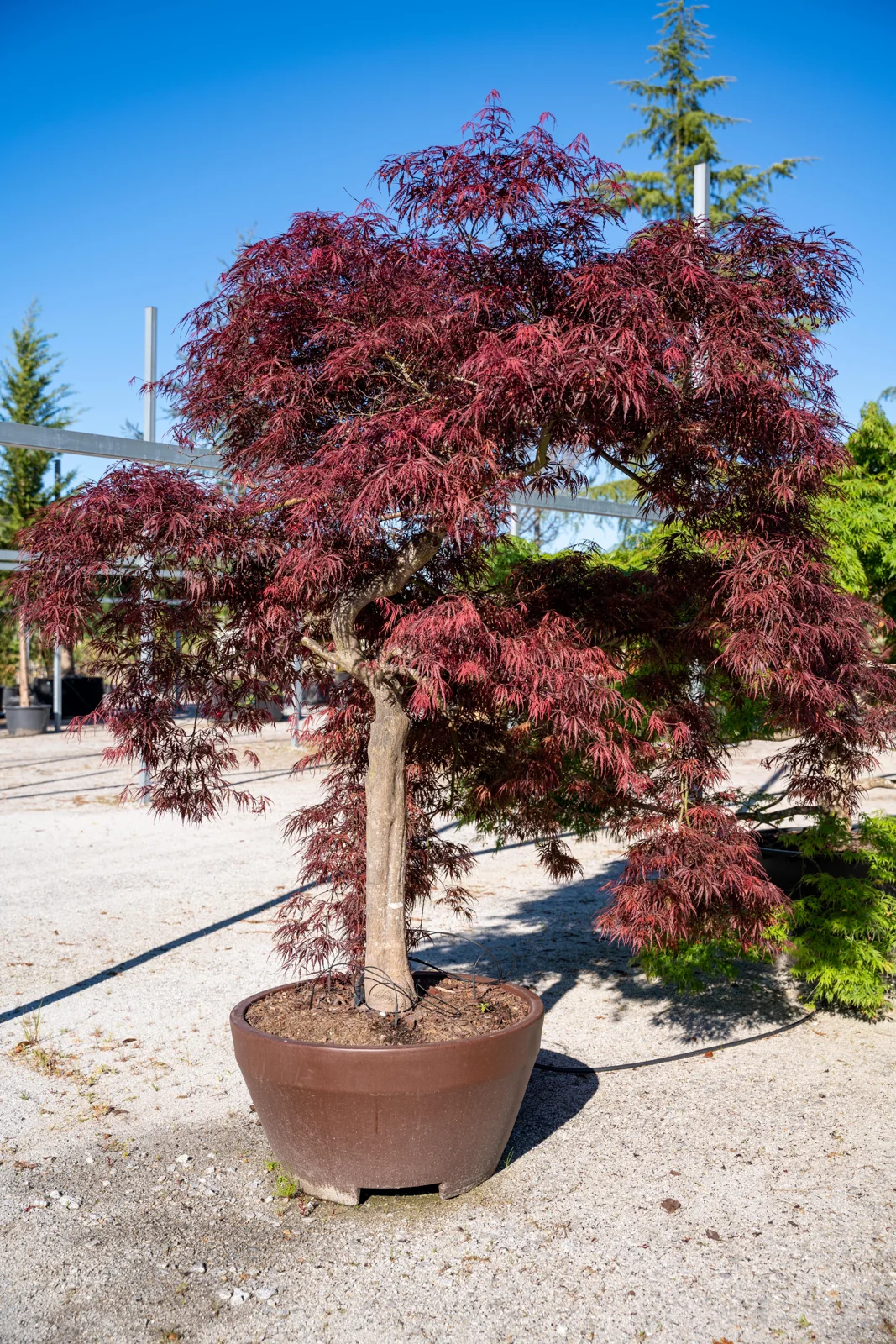
A weeping, dome-forming cultivar of Acer palmatum with deeply dissected wine-red foliage held from bud-break through summer. A small-scale specimen tree (Solitärgehölz) for sheltered Stadtinnenhöfe, container plantings, and contained Japanese-inspired compositions across the milder German Klimaregionen.
Key Facts
About this Cultivar
Compared to the green-leaved 'Dissectum' that holds reference status in German specification for laceleaf cultivars, 'Dissectum Garnet' carries the same cascading dome architecture and finely cut leaf in a deep burgundy that establishes at bud-break in May and remains stable through the summer before turning to crimson and burnt orange in October. The…
Read more
Show less
Compared to the green-leaved 'Dissectum' that holds reference status in German specification for laceleaf cultivars, 'Dissectum Garnet' carries the same cascading dome architecture and finely cut leaf in a deep burgundy that establishes at bud-break in May and remains stable through the summer before turning to crimson and burnt orange in October. The mature crown settles at roughly 2 to 3 m in height by 3 to 4 m in spread after about two decades of slow extension growth, placing the cultivar firmly in the small-stature category for German Pflanzlisten and outside any Stadtbaumeignung framework intended for canopy alignment.
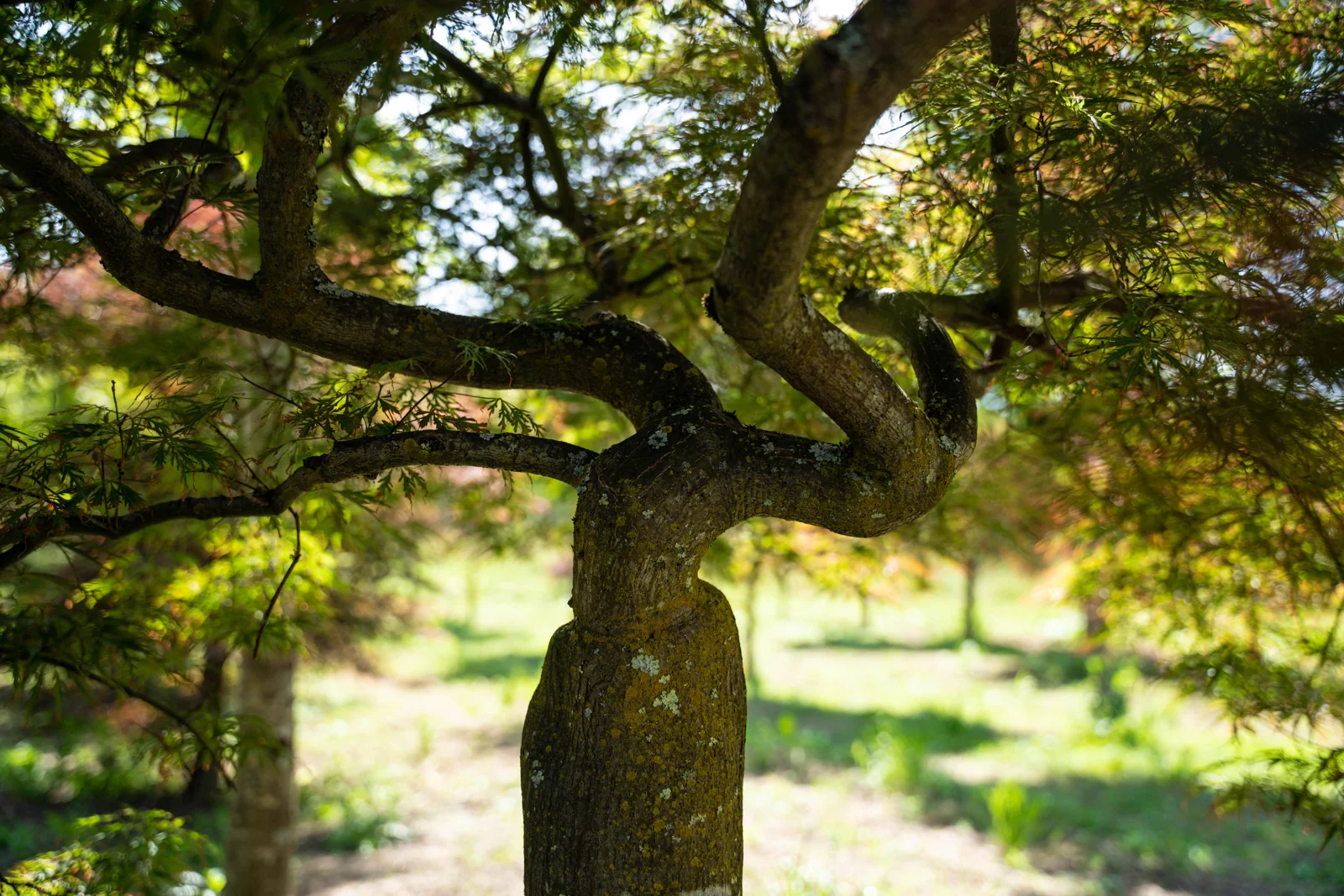
Growth rate is slow. A credible specimen comes from the nursery as a long-cycled solitary plant with the torrão (root ball, Wurzelballen) consolidated through repeated engorda cycles, not as a planting expected to develop on site. The professional case is the deliberate focal placement: a single specimen in a sheltered Stadtinnenhof, an accent at the edge of a water feature in a Kurpark-scale planting, the focal anchor of a small composition of ferns and ericaceous underplanting under aufgelichteter overhead canopy. The cultivar does not serve alignment, hedging, or volume planting.
Substrate requirements (Standortansprüche) are strict. The species needs fresh, free-draining, humus-rich substrates on the acid side; compacted urban soils and calcareous Bavarian Lössböden both fail it within a season. The correct exposure (Standort) is partial shade with morning sun. Across the Lower Rhine basin (Niederrheinische Bucht) and the pre-Alpine foothills (voralpenland) it performs reliably under light overhead cover; in the hot, dry Upper Rhine valley (Oberrheingraben) a sheltered courtyard position with afternoon shade is required, as the dissected leaf scorches under full continental summer exposure and the wine-red weakens to dull brown.
Winter hardiness (Winterhärte) reaches about -20 degrees Celsius in sheltered positions on free-draining substrate; in open positions in the eastern lowlands, sustained Kahlfrost below -18 degrees Celsius is likely to damage one-year wood, and on exposed sites east of the Elbe the cultivar is best avoided. Acer palmatum sits outside the major phytosanitary pressures of the German market: it is unaffected by Eschentriebsterben, Massariakrankheit, and Russrindenkrankheit, which simplifies its specification next to compromised genera. Maintenance is limited to a winter sanitary prune to remove dead interior wood; the habitus does not tolerate formative cutting.
Advice on this species
Want to know more about Acer palmatum 'Dissectum Garnet'?
Tell us about your project and we'll advise you on this species — where it thrives, which size makes sense, and what to expect once planted.
- Produção própria
- Exemplares adultos
- Resposta em 1–2 dias
Sem compromisso · orçamento personalizado